

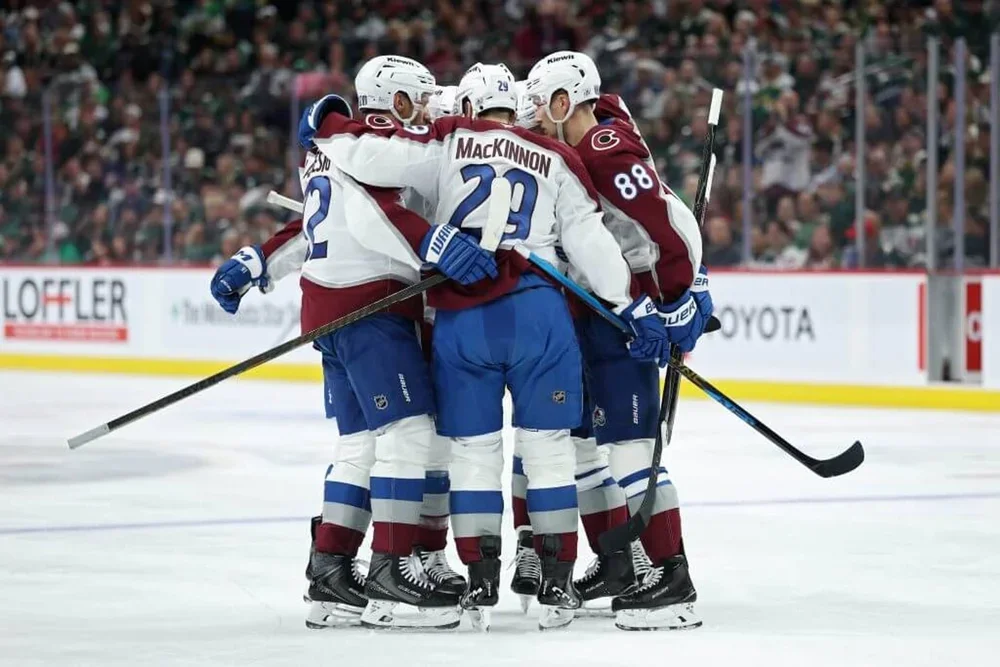
The Colorado Avalanche celebrated Nazem Kadri’s first-period goal on Monday night. David Berding / Getty Images
ST. PAUL, Minn. — The Colorado Avalanche reminded everyone why they are considered a strong Stanley Cup contender for the second time in five years with a commanding performance in Game 4 of their second-round series against the Minnesota Wild.
After losing Game 3, the Avalanche responded by dominating the first half of Monday’s contest, then showed resilience in the third period when the lead slipped away. Following Nico Sturm’s equalizer that made it 2-2, the Wild appeared to take a premature breath of relief, but Colorado ramped up the pressure for three consecutive shifts. A turnover by Jake Middleton off the glass led to Parker Kelly’s go-ahead goal, and the Avalanche sealed a 5-2 victory with two empty-net tallies.
“We were a more determined group tonight,” said Colorado head coach Jared Bednar. “I felt we were out-competed in the last game, and today we flipped that narrative. Our guys worked hard and never let up.”
The win puts Colorado one victory away from the Western Conference final, while Minnesota must win three straight games—starting with Game 5 in Denver on Wednesday—to extend their season. The Wild have rallied from 3-1 series deficits twice before, both in 2003, including once against the Avalanche.
“We had the style of game needed to win, but we consciously chose not to play that way,” said Minnesota coach John Hynes. “We’ll regroup and get ready for Game 5.”
In the third period, the Avalanche struck first when Ross Colton buried a pass from Nicolas Roy after a turnover by Daemon Hunt, making it 2-1. Just 2:19 later, Sturm—a former Avalanche Stanley Cup winner who was a healthy scratch for the first two games of the postseason—tied the game. After being denied twice by Mackenzie Blackwood earlier in the period, Sturm one-timed a Quinn Hughes pass into an open net for his first playoff goal this year and third in 37 career postseason games.
But the Wild’s fourth line, along with Middleton and Zach Bogosian, had a disastrous shift that led to Kelly’s game-winner.
“We made poor decisions with the puck, especially in the first half,” Sturm said. “Honestly, looking at the whole game, we probably didn’t deserve to win. That team is too good to get away with mistakes like turning pucks over at the far blue line or failing to clear our zone. The final score reflected the overall play.”
Hynes was blunt: “We didn’t make hard plays on a few of the goals. We had chances to get the puck out or it was on our stick, but we made soft plays.”
Jesper Wallstedt deserved a better outcome. He was outstanding early, stopping 10 shots in each of the first two periods after the Wild took a 1-0 lead on Danila Yurov’s power-play goal. But Minnesota went nearly 19 minutes without a shot at one point and was outshot 20-4 before registering eight of the final nine shots in the period. Wallstedt finished with 29 saves.
Blackwood, making his playoff debut, recorded 19 saves. “He was great,” Bednar said. “He did exactly what I hoped.”
The Avalanche also effectively neutralized Wild stars Kirill Kaprizov and Matt Boldy, who managed just one shot each. Boldy had a particularly rough night, turning over pucks repeatedly, including the last two that led to empty-net goals by Nathan MacKinnon and Brock Nelson.
“I need to do certain things to get to my game and have a bigger impact,” Boldy said.
Kadri continues to boost Avs’ power play
Colorado’s power play struggled for much of the regular season but improved after acquiring Kadri from the Calgary Flames at the trade deadline. From Kadri’s first game back on March 8 to April 7, when he suffered a finger injury, the Avalanche operated at a 23.4% success rate, ranking ninth in the league. In the playoffs, that rate has climbed to 26.1%, second among remaining teams.
“I just try to be a threat,” Kadri said earlier in the series. “I play with great players, so I facilitate the puck and take my chances. Being a mix of shooter and passer opens up lanes.”
Kadri’s productivity continued after Yakov Trenin was penalized for closing his hand on the puck. Off the opening faceoff, Martin Nečas muscled Wild defenseman Brock Faber off the puck and fed Kadri in the slot. Wallstedt made the initial stop, but Kadri buried the rebound for his ninth career postseason power-play goal with Colorado, tying Claude Lemieux, Gabriel Landeskog, and Cale Makar for 10th-most in franchise history.
“Naz has poise, patience, and sure hands,” Bednar said. “He’s excellent at taking what the defense gives you.”
The goal extended Minnesota’s playoff penalty-kill struggles, as they allowed at least one power-play goal for the 10th consecutive game—the longest such streak since the Detroit Red Wings gave up at least one in 13 straight games during the 2009 playoffs.
Manson’s butt-end sparks controversy
Veteran defenseman Josh Manson’s return from injury almost ended prematurely in the first period. After Wild center Michael McCarron finished a check on Manson, the defenseman landed on the ice and locked McCarron’s head with both hands, then butt-ended him in the neck area. McCarron rose angrily and appealed for a penalty. Referees Jean Hebert and Trevor Hanson called a major and reviewed the play.
After an extended video review, officials could not confirm that Manson landed the butt-end, so they downgraded the penalty to a double minor for “attempting” a butt-end (Rule 58.2). According to the NHL, this was only the fourth time since 2000 that this penalty had been assessed.
Former NHL referee and ESPN rules analyst Dave Jackson told The Athletic, “There is a double minor for attempted butt-ending. If they can’t be certain the stick hit him but the attempt was made, the double minor is correct.”
After the game, Manson admitted he struck McCarron with his stick but insisted he did not intend to butt-end him. He said he wanted to punch McCarron and lost awareness of his grip.
“He hits me, then lands on me,” Manson said. “We get into a scrum, and I butt-ended him. Was it on purpose? Absolutely not. My intention was to punch him in the head because I didn’t like him landing on me.”
Bednar acknowledged Manson made contact with his stick but hoped the play wasn’t severe enough to warrant a five-minute major and game misconduct, as Rule 58.3 stipulates for a landed butt-end.
“I blew him up, and he grabbed me and pulled me on top,” McCarron said. “He’s a dirty player. He clearly butt-ended me in the face. I don’t see how that’s not a five-minute. The rule book says if you butt-end someone in the face, it’s five minutes. He’s always been dirty and not well-respected.”
Manson fired back: “If he wants to call me dirty, he can look at my record—13 years without a suspension. Was that play clean? No. Was it intentional? No. I served my time, and they scored on it anyway.”
Indeed, on the back end of the double minor, Yurov redirected Faber’s shot for his first career playoff goal, giving the Wild a 1-0 lead heading into the first intermission.
Yurov continues strong play in Eriksson Ek’s absence
Yurov has improved throughout his first playoffs and finally got rewarded with a power-play goal in the first period. With Joel Eriksson Ek sidelined by injury, the 22-year-old has been playing on the second line with Marcus Johansson and Matt Boldy. Boldy