

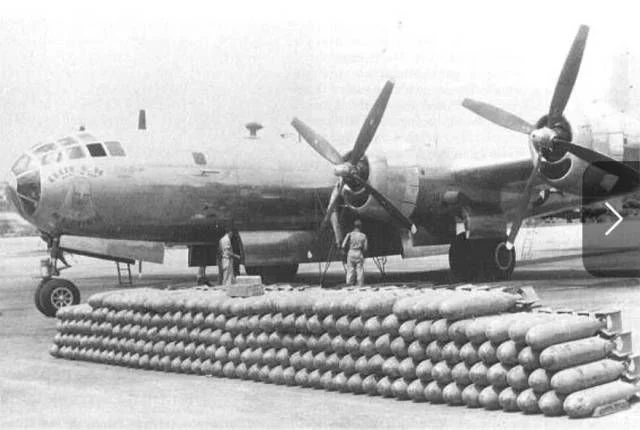
On July 29, 1944, three American B-29 bombers made an emergency landing at a Soviet airfield in the Far East. The pilots radioed Washington, requesting permission to bring both the aircraft and their crews back home.
Stalin kept the planes but let the crews go. At that time, the Soviet Union’s most advanced bomber had only half the range and one-third the payload capacity of the B-29.
Stalin summoned Andrei Tupolev to his office and slid a photograph across the desk. It showed the B-29. Stalin spoke just one sentence: “Build an exact copy.”
Tupolev asked, “How exact?” Stalin replied, “Exactly the same.”
Back at his design bureau, Tupolev gathered his team and told them, “We are not imitating – we are photocopying.” He had the B-29 towed into a hangar and gave the order to disassemble it. Not a rough tear-down – every single screw, wire, and sheet of aluminum was removed, weighed, numbered, drawn, and chemically analyzed. That added up to 105,000 individual parts. Just the disassembly process took two months.
When an engineer suggested switching from American imperial threads to the more convenient metric system, Tupolev refused. When another pointed out that the U.S. aluminum skin was 1/16 inch thick, a size the Soviet Union did not produce, Tupolev ordered a new rolling line to be built just for that gauge. When the insulating material on the American wiring differed from Soviet standards, Tupolev insisted on replicating it exactly.
The entire Soviet industrial machine was pulled along by the demands of copying one American plane. It has been estimated that more than 900 new manufacturing standards were created for this project.
One engineer discovered a seemingly useless aluminum plate in the rear fuselage with a hole in it. He could not figure out its purpose and asked Tupolev whether to remove it. “Leave it,” Tupolev said. Later, it turned out that the hole was a mistake made by an American worker who had drilled in the wrong spot. The Soviets replicated that error perfectly.
In August 1947, the Tu-4 flew over Moscow’s Red Square. Western observers saw three aircraft and assumed they were the original captured B-29s performing a flyover. Then a fourth, fifth, and sixth appeared – an entire formation. The Americans had spent three hundred million dollars and five years developing the B-29. The Soviets built the Tu-4 in less than two years.
More significantly, during the two years of dismantling that aircraft, the Soviet Union dragged its entire industrial base – metallurgy, electronics, rubber, instrumentation – up to the level of the B-29.
In his later years, a student asked Tupolev what the greatest lesson from those two years had been. He did not speak of technology, speed, or catching up with America. He said just one word: “Seeing.”
When the student did not understand, Tupolev explained: “Before, we had been building airplanes we imagined. After we took apart that B-29, I realized that there really are people in this world who can make every detail reach a level we thought impossible. It wasn’t that we lacked technology – we simply didn’t know what ‘excellent’ looked like.”
Note: This account is based on historical events but is not a rigorous historical description and is provided for reference only.
