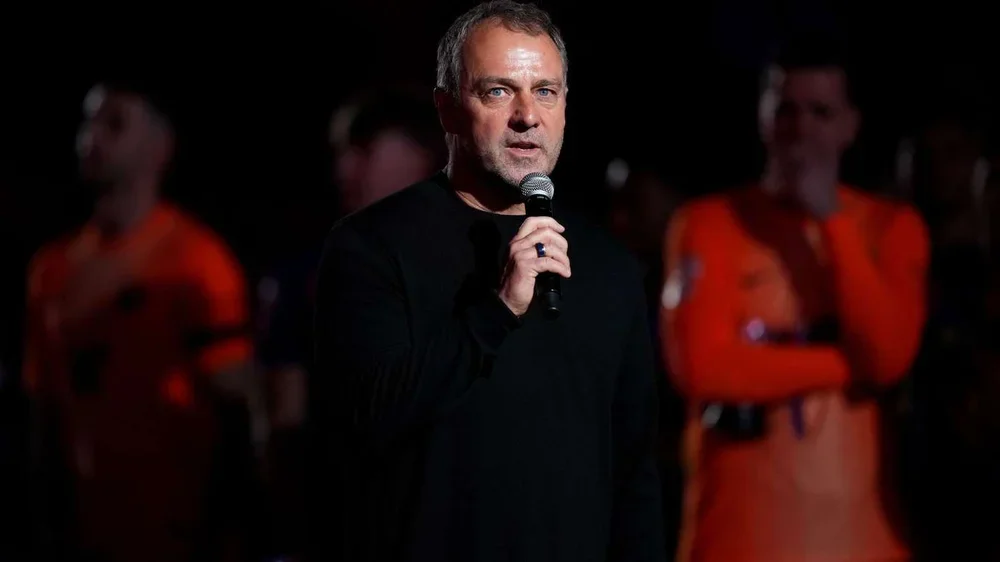


In a striking display of double standards, the reaction of German coach Hansi Flick to his player Lamine Yamal raising the Palestinian flag during Barcelona’s La Liga title celebrations has sparked widespread criticism, especially compared to his earlier, stern stance on human rights during the 2022 World Cup in Qatar.
Flick, who was one of the most prominent European voices criticizing Qatar’s hosting of the tournament and who openly linked football to politics and human rights, now demands the separation of sports from politics when the topic is Palestine. This glaring contradiction raises fundamental questions about the selective nature of human rights advocacy in European circles.
**September 2022: Flick Launches a Fierce Attack on Qatar**
In September 2022, just weeks before the World Cup, Flick was clear, direct, and sharp in his criticism of Qatar hosting the event.
In an interview with the German press at the time, Flick stated: “Was it right to award Qatar the World Cup? This question should have been answered a long time ago. And the answer is no!”
He added firmly and without hesitation: “The truth is that in Qatar, when it comes to human rights and sustainability, there are many things that are not right, and that is obvious.”
Flick was not shy or reserved in his stance; he was explicit in his political condemnation of Qatar.
**Human Rights a ‘Major Priority’ in Qatar**
Flick did not stop there. The German coach emphasized that “human rights must be a major priority when awarding the hosting of tournaments,” a clear statement linking football, politics, and human rights.
**Comprehensive Criticism from All Angles**
Flick also clearly pointed to the suffering of minorities in Qatar, especially the LGBTQ community, in an unequivocal political stance.
**Symbolic Protests on the Field**
During the World Cup itself, Flick went beyond words and led the German national team in a series of explicit and direct symbolic protests.
The German team participated in protesting the specific ban on the LGBTQ rights armband. After FIFA threatened sanctions (a yellow card for anyone wearing it), seven teams, including Germany, decided not to wear it to avoid the sporting penalty.
**Covering Mouths: A Direct Political Message**
But Flick did not give up. Before Germany’s match against Japan in the World Cup, the German players staged an explicit and direct protest: they covered their mouths with their hands in the official team photo before the match, a clear message of protest against what they saw as “muzzling” by FIFA.
This explicit political scene was broadcast live to millions of viewers worldwide, with no ambiguity in its political message.
**’FIFA Muzzles Us’**
Immediately after the match, Flick came out to clearly explain the political message he wanted to send, without any shame or hesitation. Flick stated bluntly: “This was a signal and a message we wanted to send. We wanted to say that FIFA is muzzling us.”
He added in a strong and decisive statement: “Human rights are non-negotiable. They should be a given, but they are not.”
**May 2026: Flick’s Tone Changes Completely**
However, the scene changed entirely in May 2026. When Lamine Yamal raised the Palestinian flag during Barcelona’s celebrations for winning the La Liga title—a scene that garnered widespread praise from Arab and international audiences and spread significantly across social media and international outlets—Flick did not see it as an expression of human solidarity or support for a people suffering under occupation, siege, and killing for decades.
On the contrary, the German coach expressed his clear and explicit displeasure with his young player’s action.
**’These Are Things I Usually Don’t Like’**
In a press conference before the match against Deportivo Alavés, Flick was direct and firm in expressing his discomfort with Lamine Yamal’s behavior.
The German coach stated clearly and directly: “These are things I usually don’t like.”
He added, clarifying his position: “I spoke to him and told him that if he wants to do it, it’s his personal decision. He is an adult now.”
In this statement, Flick appears to completely distance himself from the situation, placing the full responsibility for the “mistake” on the player. This is a stark contrast to his stance in Qatar, where he led the protests himself, defended them publicly, and explained them to the media.
**We Dedicate Ourselves to Playing Football**
Flick continued to clarify his new vision, which completely contradicts what he said and did in Qatar: “We dedicate ourselves to playing football, and we must take into consideration what people expect from us. When you see people on the streets crying with joy, you realize why we are here. For me, that is what matters most, the top priority.”
These words seem to come from a different coach entirely, not the one who said in Qatar that “human rights are non-negotiable,” that FIFA “muzzles us,” and that “human rights must be a major priority.” Suddenly, football must stay away from politics, and “what people expect” has become the top priority, not human rights.